Wednesday, June 20, 2012

Aquino's proposed six point agenda on mining


The following are the points considered in the proposed Executive Order, we don't have a copy of the one which has been submitted to President Aquino.

What can you say?

THE SIX-POINT AGENDA TO ENSURE RESPONSIBLE MINING

Agenda 1: Ensure responsible mining's contribution to the country's sustainable development (i.e. economic and social growth and environmental protection);

Agenda 2: Adopt international best practices to promote good governance and integrity in the sector

Agenda 3: Ensure the protection of the environment by adopting technically and scientifically sound and generally accepted methods as well as indigenous best practices

Agenda 4: Enforce the primacy of national laws over local issuances and harmonize laws, policies, and regulation

Agenda 5: Ensure a fair, adequate, and equitably shared economic benefit for the country and the people

Agenda 6: Deliver efficient and effective management of the mining sector, both large and small scale

-----------------------

Office of the executive Secretary – Strategic Initiatives and Monitoring Office (SIMO) 1

Six-Point Agenda on the Aquino Administration's Mining Policies with Specific Recommendations

PROPOSED ACTIONS TO IMPLEMENT THE 6 POINT AGENDA ON RESPONSIBLE
MINING

Agenda 1: Ensure responsible mining's contribution to the country's sustainable development (i.e. economic and social growth and environmental protection)

o Create an inter-agency council on mining and ensure participation and transparency in the mining industry

o Conduct public bidding/public auction of mining rights/tenements (abandon "first come, first serve" policy) for areas with known mineral resources

o Create an entity that will formulate standards, technicalities and financial framework of identified "frontier land" or "greenfields."

o Demand operational and financial reports from the mining contractors at all stages of the mining cycle

o Maintain revenue baseline data and properly account for all taxes and fees generated from mining

o Conduct verification at the national, regional and local levels of taxes and fees payable to Government, and monitor all existing and possible entry and exit points

o Provide alternative livelihood for displaced mining workers (especially in illegal mining operations)

o Properly account for and make public the Social Development and Management Programs (SDMPs) and the Environmental Protection and Enhancement Program (EPEPs)

o Ensure appropriate social protection measures are in place for vulnerable and marginalized sectors affected before, during, and after mining activities (i.e., labor-market programs, social and health insurance, and social safety nets)

o Explore the possibility of compulsory and mandatory insurance coverage for the affected environs and communities, as well as perpetual liability for the maintenance and rehabilitation of post mining sites (i.e., setting up trust funds or heritage funds with specified uses)

o Study the possibility of adopting the Comprehensive Environmental Response, Compensation and Liability Act (CERCLA) of the USA commonly known as the Super Fund

o Include in the Final Mine Rehabilitation and Decommissioning Plan (FMRDP) the determination of the final land use of the area once mining has been completed and the provision of funds by the mining companies for the said development Increase penalties for all mining-related offenses and enforce strict measures (including labor related laws) aimed at catching and penalizing offenders (including foreigners actually doing mining)

o Craft a definition of Medium Scale Mining and the rules that will govern its operations

o Clarify the definition of small-scale mining and its scope, including who can apply for SSM contracts (should allow for mining associations and not be limited to individuals and cooperatives only).

o Provide for regulatory rules over traders and middlemen in the sector

o Enact a Comprehensive Mineral Code to cover the mining sector

Agenda 2: Adopt international best practices to promote good governance and integrity in the sector

o Create a Task Force Against Illegal Mining ( i.e. go after foreigners who are mining illegally)

o Implement a 'One-Stop-Shop' process for mining applications

o Provide additional staff and equipment to concerned government agencies (i.e., MGB, BOG, NCIP, BIR)

o Determine individual roles of agencies concerned and fix overlapping tasks and functions (i.e., MGB v. NCIP, MGB v. LGUs, etc.)

o Support the participation of the Philippines in the Extractive Industries Transparency Initiative (EITI)

o Formulate mechanisms to monitor Human and Labor Rights Violations and develop operational linkages with the Commission on Human Rights (CHR) and DOLE to assist victims

Agenda 3: Ensure the protection of the environment by adopting technically and scientifically sound and generally accepted methods as well as indigenous best practices

o Identify additional areas closed to mining (i.e., prime agricultural lands as determined by the Department of Agriculture, priority eco-tourism sites as determined by the National Ecotourism Council, critical areas and island ecosystems, among others)

o Create a separate environmental protection commission/agency to handle environmental regulation functions of the DENR

o Adopt Programmatic and/or Sectoral Environmental Impact Assessment (EIA) in the Philippine Environmental Impact Statement System (PEISS)

o Use the geo-hazard maps/mufti-hazard maps for the country and forecast of climate change impacts to determine "go" and "no-go" areas for mining based on areas reserved by law and executive issuances

o Consider the impact of the New Rules of Procedure for Environmental Cases for mining operations

o Strictly and consistently enforce environmental laws, rules and regulations.

Agenda 4: Enforce the primacy of national laws over local issuances and harmonize laws, policies, and regulation

o Enforce primacy of national laws over LGU issuances

o Push for the amendment of laws to remove gaps and conflict (i.e., conflicting jurisdictions of MGB with NCIP, LLDA, and LGUs in certain mining areas, no clear laws for mining in island ecosystems, where to mine and not to mine, etc.

o Stipulate the utilization of LGU share in mining revenues in mining laws, rules and regulations

o Study direct access of LGUs to their shares and increase LGU share

Agenda 5: Ensure a fair, adequate, and equitably shared economic benefit for the country and the people

o Reinforce State ownership of all mineral resources including valuable miners s in mine wastes and mill tailings and get government's due share when utilized, without prejudice to liabilities of mining contractors for the said wastes and tailings facilities

o Establish mineral reservations for the development of strategic industries for the collection of royalties from mining contractors, which shall be prospectively applied

o Encourage and promote the use of foreign technical assistance (FTAA), joint venture and co-production agreements in mining contracts (with appropriate guidelines on formula to be used; to facilitate negotiation of better sharing schemes (e.g. 50-50 net of taxes)

o Study the possibility of applying appropriate Home State rules and regulations on foreign mining companies operating within the Philippines through bilateral agreements

o Develop with the participation of the private sector and the academe a road map for the establishment of value-adding and/or downstream processing of minerals in the country

o Ensure inter-agency coordination relative to Government share in mining revenues; and hasten LGU access to their share in mining revenues (similar to PEZA share)

o Study how LGUs can get direct access to their share (similar to PEZA)

o Review existing taxes, fees, and incentives being given to mining companies (Review the Omnibus Investment Code/IPP) and leveraging employment generation/jobs

o Update the mineral commodity profile, conduct studies and build database on new markets, products and available technologies towards the development of downstream industries

o Consider tapping 3`d party international auditors to validate the volume and value of mineral exports in the Philippines

o Study existing fiscal schemes, processes, and procedures being utilized for oil, gas, and other energy-related extractive industries being utilized by DOE (If found feasible, could lead to proposed legislation)

o Study possibility of imposing "windfall profits" tax or share on mining companies (If found feasible, could lead to proposed legislation)

o Amend provision of the Philippine Mining Act on incentives for the mining industry

Agenda 6: diver efficient and effective management of the mining sector, both large and small scale

o Provide additional staff and equipment to concerned government agencies (i.e., MGB, BOC, NCIP, BIR)

o Engage in training and capacity building measures for concerned NGAs and LGUs (i.e., DENR-MGB, BOC, NC{P. BIR, etc.)

o Establish a public, accessible, and comprehensible database which consolidates all relevant data from all concerned stakeholders and sources (which includes maps under the proposed one-map system for government of mining areas, protected areas, ancestral lands and domains, among others)

o Implement a 'One-Stop-Shop' process for mining applications

o Ensure the declaration of Minahang Bayan areas pursuant to RA 7076 and the operationalization of Provincial/City Mining Regulatory Boards (P/CMRBs) in all SS mining areas

o Complete cultural mapping to identify Indigenous Peoples (IP) areas to complete the ancestral domain delineation process and address IP concerns/recognition of {P rights

o Streamline and improve the EPIC and certificate precondition process Ensure proper working and safety conditions for mine workers and people from nearby communities/ensure that proper benefits are given to mine workers (i.e. PhilHealth, Pag-lbig, SSS. Hazard Pay and Insurance)

o Ensure the social preparation for !Ps who will be affected by mining

o Explicitly clarify the preferential rights of the IPs

o Create a Task Force Against Illegal Mining (i.e., go after foreigners who are fining illegally)

Aquino says mining EO out by June 22

http://www.rappler.com/business/7330-aquino-says-mining-eo-out-by-june-22

MANILA, Philippines - The much-awaited executive order on the government's mining policy may be out by Friday, June 22. 

In a press briefing in Davao City on Wednesday, June 20, President Aquino said he is hoping to release the mining E.O. within the week, or after some details, especially on the revenues received by the government, are fine-tuned.

"The basis to impose higher fees or royalties, etc, is also being fleshed out," he told reporters after he attended the ARMM Convention on Local Governance. 

He reiterated his previous concern about the economic, legal and environmental issues that hound the industry. He said the part on revenue sharing will determine if legislation is needed to ensure a better share for the government.

"Presently, it's about 2% (of income taxes paid), if my memory serves me right. The total taxes involved will not even reach 10% of what they are making from the extraction of our resources. That's not fair. We get less than 10% (from the mining companies), but we [pay] 100% in case there's a problem," he said, referring to the difference between the economic returns and costs. 

He also reiterated the 78 placed designated as eco-tourism areas where mining cannot take place, as well as designate the "minahan ng bayan" areas where small scale miners can operate.

He said small scale miners will be subjected to more regulation under the new mining policy. 

President Aquino himself sought for the comprehensive review of the government’s mining policy and the industry’s environmental and economic impacts. He was also concerned with safety issues and the dislocation of indigenous peoples.

On Tuesday, June 19, Executive Secretary Paquito N. Ochoa Jr. said the final draft of the EO has been submitted for President Aquino's approval

In a statement, Ochoa described the proposed EO as an effort to "strike a balance between interests or supposedly conflicting interests between the mining industry and the environment, among others." 

Ochoa said the proposed mining policy, if approved, will harmonize conflicting policies on mining. This is a critical issue. Conflictling national and local policies have resulted in various problems in the industry. 

“Hopefully, we will be able to put some order in approving and in handling mining applications,” Ochoa said.

The mining EO was supposed to be issued last February but mining companies asked to get more involved in the crafting of the mining policy. - Rappler.com

Monday, June 18, 2012

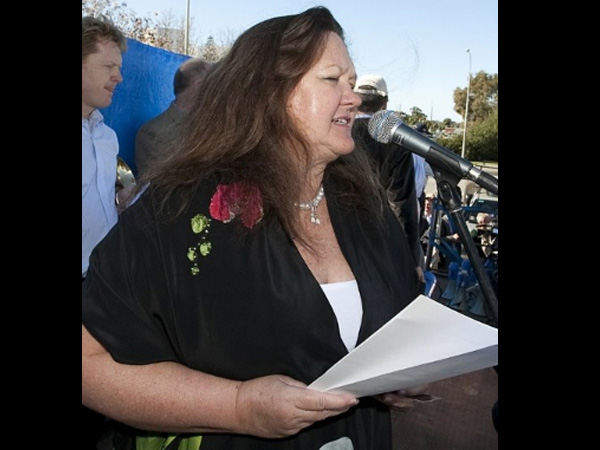
World’s richest woman raises Fairfax stake

Photo by AFP / Tony ASHBY
http://business.inquirer.net/65771/worlds-richest-woman-raises-fairfax-stake


SYDNEY – The world’s richest woman Gina Rinehart has boosted her stake in ailing Australian media giant Fairfax to 18.67 percent as she bids to win a board seat, it was revealed Monday.
The mining billionaire increased her holding from 12.58 percent, according to a regulatory filing.
She has been critical of the company management and her move came as Fairfax said it would slash 1,900 jobs and erect paywalls on its flagship titles in a major overhaul towards a digital future.
As part of the plan, the Sydney Morning Herald and The Age in Melbourne will shift from broadsheet format to a more compact, tabloid size and two printing facilities will be shut.
Rinehart, who is worth Aus$29.17 billion (US$29.48 billion) according to an annual index by Business Review Weekly, has so far been unable to secure a seat on the Fairfax board despite being the company’s biggest shareholder.
Her initial move into the company earlier this year prompted the government to flag stronger media ownership laws amid concerns that the tycoon, who has been critical of the government, wanted to build her influence.

Wednesday, June 13, 2012

Mining in the Philippines: Creating Growth Opportunities for All?

An article written by Thomas Graham taken from http://www.voicesthatmatter.net/the-philippines/205-mining-in-the-philippines-creating-growth-opportunities-for-all.html

Any comment? Read on...

---


Despite having some of the biggest mineral reserves in the world - including gold, copper, manganese and iron- mining has long been a hot and -at times- controversial topic in the Philippines. A strong anti-mining movement led by the influential Catholic Church, in addition to poor infrastructure and security concerns, have at times kept investors away, whilst the recent review of mining legislation leading to the government moratorium on mining has merely served to add more fuel to the debate. In fact, on a global level, given the growing levels of resource nationalism prevalent today, whether in stable emerging markets like Indonesia and South Africa or in developed nations such as Australia and Canada, it appears that doors everywhere are harder, more expensive or just plain dangerous to open. Much of this is due to growing perceptions that the industry is taking away from local communities more than it is putting in. With this in mind, Voices That Matter got together with Mr. Benjamin Philip G. Romualdez, President of the Chamber of Mines in the Philippines, to discuss the role the mining industry can play in promoting the inclusive, sustainable growth demanded by the current Filipino government under President Aquino.
Whilst different pressure groups tend to paint the picture of a mining industry which destroys both the local environment and rural communities, the industry itself has perhaps been slow to stand up for itself. Mr. Romualdez feels it is unfortunate that the public is not able to see a more balanced version of the events, and he is particularly keen to promote the role the mining industry has been playing in supporting local communities: “Corporate Social Responsibility is just a new, modern term for something which mining companies have been putting in practice for years. In certain cases we provide goods and basic services to communities where the government failed to do so. We have built schools and infrastructure where there is none.” In terms of the environmental concerns, Mr. Romualdez admits that mistakes have been made in the past, but links this to the mistakes made all over the world in terms of environmental damage ever since the evolution of our increasingly industrialized society: “Some of these issues of environmental sciences have perhaps only come to the fore in the past 10-20 years, so perhaps for some older companies there was no real understanding, in the past, of these concerns. However, as mining companies became aware of them, they quickly started to address them.”
Strangely, at a time when growth from emerging economies has driven demand for natural resources to record levels, the relative importance of the mining sector to the Philippines’ overall economic growth appears to have been downplayed. However, to not recognize the significance of the role mining could play in the Philippines’ economic development would be a major mistake, according to Mr Romualdez: “There are different catalysts of growth in any economy, and mining is definitely one of those. It has also been a key factor in driving foreign investment in the country. It is also vital because it is the basic necessity of any economy. Everything that you enjoy in the world today either has been mined or grown. This is a key element which people fail to understand or grasp.”
Therefore, at a time when legislation regarding the mining industry is being debated by the powers that be, it is vitally important that the Philippines is able to present legislation which is both fair to the local population and also attractive to foreign investors. Mr Romualdez feels it is particularly important that the Philippines gets things right, as this may in turn set important precedents for the Filipino economy at large: “All forms of infrastructure development, energy or major manufacturing projects will experience similar concerns to those which we are currently facing, whether regarding the implementation of local/national planning, or community/ environmental concerns. Governance issues are at play in the Philippines. How these projects move forward will clearly indicate how other similarly placed projects will experience challenges.”c
Overall, Mr Romualdez is clearly confident that the newly revised legislation can be both “comprehensive” and “strict” enough to satisfy the justifiable interest of environmental and community-focused group, and yet reliable and fair enough to attract investors into the sector: “Given the highly mineralized nature of the Philippines, and this country’s highly-skilled and experienced labour force, I think investors will see that you have a wonderful business opportunity here in the Philippines.”
This will not only benefit foreign investors, but most importantly it will benefit the Filipinos themselves: “The biggest misconception is that we are preparing the mining industry for the benefit of others, and not for the Filipinos themselves. In fact, we are preparing it for the Filipinos; we are simply using the fact that there are other people interested in utilizing those minerals and benefiting from them. Our view is that we’re creating an atmosphere from which there is a win-win for all around. Filipinos can utilize the resources which belong to them to provide opportunities for opportunities for investors, or for those that have the skills set and would like to work within it.”
Through guidance from the Philippines’ Chamber of Mines, as well as the implementation of best practices from a number of the country’s most respected players in the mining sector, perhaps mining can play a major role in the Philippines’ quest for inclusive, sustainable growth after all.

Monday, June 11, 2012

High-paying mining jobs bring big-city woes to small Australian towns


Despite a six-figure salary, Russel Wise is worried he will soon be homeless after receiving an eviction order from the one-room trailer he has rented since taking a job in an Australian coal mine in 2009.
 
"There aren't too many options around," says Wise, who like thousands of other Australians, was lured to the little town of Moranbah in the coal-rich northeast by high-paying jobs and in the process triggered a housing crisis of big-city proportions.
 
"The owner wants to build more modern, multi-dwelling units to house more people the mining companies can bring in and out on rotation, so I've got to go. Simple as that," says Wise.
 
The property crunch engulfing Moranbah and other communities peppering the Bowen Basin, a 60,000-sq-km (23,200-sq-mile) moonscape of open pit mines supplying most of the world's coal for steel making, is one of a swelling number of downsides associated with the Australian mining boom.
 
Add to the list rising food prices, constant truck traffic, outbreaks of sexually transmitted diseases and near-non-existent health care to name a few, according to town residents, health professionals, mine workers and community advocates interviewed by Reuters.
 
Jetting in employees on charter flights from mostly large cities to work 12-hour shifts for two weeks straight and then fly them home for a week off has long been commonplace in Australia's remote mining locations, where no towns exist.
 
But the growing demand for commodities in Asia is encouraging mining companies to dig deeper and faster than ever before near established communities like Moranbah, requiring thousands more workers than local townships can supply.
 
Mining company executives say they are trying to attract more employees to move permanently to the towns with their families to alleviate some of the problems associated with mobile work forces, but it is proving a hard sell.
 
A recent survey of mine workers suggested at least half have no interest in relocating permanently to mining towns, which can be lacking in social outlets much beyond a local pub and fast-food restaurants.
 
"This place is okay when you're working, but on a pyjama day I'm bored stiff," says Richard Spaffey, who is sub-contracted to a mining company based in his hometown of Perth, 3,600 km (2,200 miles) away, referring to a day off. "I'll head into town and the ratio of men to women will be fifty to one."
 
Prostitutes
 
A prostitution advocacy group, called the Scarlet Alliance, is appealing to the government for help in servicing the mining communities, promoting regulated sex work as a safe alternative to unsupervised liaisons that can cause the spread of disease.
 
By one government estimate, Australia will need an extra 89,000 mine workers over the next five years.
 
As a result, mining towns like Moranbah are bracing for even greater population growth around the mines.
 
One of Australia's richest people, Andrew Forrest, who made billions mining iron ore, is heading a group aiming to train 50,000 Australian Aboriginals to work the mines.
 
Also, despite opposition from unions, Prime Minister Julia Gillard last month said more than 1,700 foreign workers could be brought in to work constructing one mine alone under special visas, underscoring the sector's dire need for labour and opening the door to further jobs immigration.
 
In the United States and across Europe, jobs fairs promoting work in Australia's resources sector already draw thousands of attendees.
 
"What this says loud and clear is that it is important for resources sector companies to be able to offer accommodation options," says Michael Roche, chief executive of the Queensland Resource Council, which lobbies on behalf of coal mining.
 
Australia is also easing immigration rules for farm workers applying for visas from Pacific islands like Papua New Guinea and Fiji to compensate for an exodus of workers from sugarcane fields to better paying mining jobs.
 
A programme is even under way to pay unemployed people to move to rural mining communities to work jobs indirectly connected to mining.
 
These too can be lucrative. In Moranbah, the local Dominoes pizza shop can't find enough drivers to pay A$25 per hour to make deliveries. On the outskirts of town, a billboard advertises electricians' jobs starting at A$60 an hour. The currency is roughly the same value as the U.S. dollar.
 
Three to a bed
 
John Wood, a property manager for Moranbah Real Estate, says many of the town's long-term residents had sold their homes by mid-2011 for hefty profits to investors now renting rooms for as much as A$1,800 a week.
 
"In many cases, the mining company subsidises the rent, so someone might only pay A$65 of that each week," he says. "It's actually got kind of slow. There's not much left out there to sell."
 
According to the Queensland Resources Council, 72 percent of workers renting accommodation receive subsidies.
 
In some instances, this has led to "hotbedding" or sharing of a single bed by up to three workers who stagger their shifts to keep out of each other's way.
 
Mining companies are trying to keep up with the population explosion by erecting thousands of modular workers' "villages" around the towns, but are seen doing little else to alleviate burdens on the community.
 
"Almost universally, people have noticed that FIFO (fly in, fly out) workers have increased levels of mental stress and mental illnesses (and) quite significant increases in alcohol and other drugs," Dr David Mountain, of the Australian Medical Association, told a parliamentary hearing in April.
 
Dr Reyno Nieuwoudt doubts few if any of the four doctors working at his private clinic on a Moranbah side street will be around by the end of the year, driven away by the workload.
 
"On average, we'll see up to 70 patients a day each and that's way too many," Nieuwoudt says. "That's way above the healthy average and quite frankly impossible to sustain."
 
Last week, the doctor who ran Moranbah's only other medical clinic closed and moved away. The town has been without a dentist for more than a year.
 
"At this pace, I won't be here much longer either," Nieuwoudt says.
 
As more mines are dug, there is a growing belief in Moranbah that mining companies prefer mobile work forces because it relieves the company of a responsibility to provide housing.
 
But Stephen Dumble, asset president of BMA, a joint venture between BHP Billiton and Mitsubishi which operates six coal mines, says BMA is constantly trying to recruit permanent residents. They are cheaper in the long run, because non-resident employees mean higher turnover, boosting costs for recruitment and training.
 
A survey by the regional council of Isaac, which takes in the Bowen Basin, suggests non-resident workers on average last about 18 months before becoming "tired" and quitting.
 
"Over the next two years, we will build 383 houses and townhouses across Central Queensland and we are spending A$54 million refurbishing a further 450 family homes," Dumble says. - Reuters

Friday, June 8, 2012

Filipino protests slam Australian military pact


Protesters in the Philippines reject a proposed
Visiting Forces Agreement with Australia, June 6.

Anti-war and progressive groups in the Philippines have asked for Australian support against a Status of Visiting Forces Agreement (VFA) between Australia and the Philippines currently before the Philippines Senate for ratification.
On June 6, there were two anti-war protests against the VFA, which is seen as part of a US-led military build up in the Asian region aimed at China.
The US used to operate huge military bases in the Philippines under the Marcos dictatorship. After Marcos was toppled by peoples power uprisings, these agreements were revoked.
However, subsequent Filipino governments have used VFAs to effectively re-base significant US military forces in the Philippines, particularly in and around the southern island of Mindanao. There, insurgent left and Moro national liberation groups say US special forces and even drones have been used against them.
Article 5, para. 1 of the Philippines-Australia VFA provides that the "Visiting Forces" may temporarily use such defined land and sea areas, air space or facilities, of the Receiving State mutually determined by the Parties, for "combined training, exercises, or other activities mutually approved by the Parties."
Filipino anti-war activists are concerned that a VFA with Australia will be used to help further repress liberation movements.
Australia’s Department of Foreign Affairs and Trade (DFAT) said each year Australia spends $4-4.5 million on “bilateral military cooperation”. These include “high level policy talks, training of approximately 130 Philippine defence personnel in Australia, and visits by senior officials”.
The military relationship, says DFAT, is “focussed on counter terrorism, maritime security and assistance to the Philippines Defence Reform Program”.
During former Philippines President Gloria Arroyo’s visit to Australia in May 2007, a bilateral Status of Visiting Forces Agreement was signed. This pact is now being considered for ratification by the Philippine Senate.
Reihana Mohideen from the Party of the Labouring Masses (PLM) told Green Left Weekly: “About 50% of the US war fleet is in the Asian region (it is projected to rise to 60% by 2020) and the anti-war movement here sees Australia as the major military partner of US imperialism in the region.
“The VFA with the US was signed in 1998. It has allowed a permanent presence of US military forces in the Philippines without having permanent bases like there used to be under the Marcos dictatorship.”
It has allowed a permanent US military presence, Mohideen said, especially in Mindanao under the guise of ongoing military exercises.
“We know they have participated with intelligence personnel in on-the-ground operations against Moro liberation movement. We have had reports, recently, of drone attacks very similar to those being carrioed out by the US in Pakistan. This is a stepping up of covert and overt military intervention in the Philippines.
“Another aspect is the question of who has legal jurisdiction over these ‘visiting’ military forces. And it has been found that the Philippines has no juridiction.
“There was a case of the rape of a young woman by a US soldier a few years ago where the US asserted its legal jurisdiction over the offender.
“In the light of this experience we now have a similar agreement that has been signed with the Australian government. It is only now that this agreement has come before the Senate that the movement has been made aware of its existence.”
Australia, added Mohideen, is the “number one military ally of US imperialism in the region”. She said Australia had its own direct interests, such as mining.
“Australian mining companies are ravaging Indigenous communities in Mindanao and in central Philippines. This is a real concern.
“The Senate is now deliberating the ratification bill. It has been delayed because seven Senators now oppose it. If eight Senators oppose it this will block the bill when it is reconsidered in July.
“So we are calling for urgent solidarity from the movement in Australia in our struggle to block this military agreement which is going to be detrimental to the people of the Philippines.”

Letter to President Aquino: Reject SMI/XSTRATA Mine Proposal in Social Justice


June 8, 2012
His Excellency Benigno Simeon C. Aquino, III
President of the Republic of the Philippines
New Executive Building, Malacañang Palace
J.P. Laurel St., San Miguel, Manila
Your Excellency:
Peace!
We are gratified that Sagittarius Mines, Inc. (SMI)/XStrata has been denied environmental clearance for the second time for its controversial $ 5.9 billion project straddling South Cotabato, Sultan Kudarat, Davao del Sur and Saranggani. The disapproval, “without prejudice to resubmission” (DENR order dated May 22, 2012), in my view, should be final and absolute. The disapproval should not just be based on the standing ordinance of South Cotabato against open-pit mining, but on appreciation of the incontrovertible information that has emerged on the impacts of the project on the environment and the people of Mindanao.
Several conferences, fora and fact-finding missions have concluded many reasons to reject the Tampakan Mine Project. Let me briefly enumerate some of these risks the mine poses to our human, ecological and cultural heritage:
• THE BIGGEST HOLE IN THE PHILIPPINES WILL POISON RIVERS.
Slated to become the biggest mine in the Philippines, the Tampakan Mine of SMI/Xstrata covers 10,000 hectares, destroying in its lifetime 4,000 hectares of water catchment forests, including old-growth forests. It risks polluting the water source of communities depending for their livelihoods on six rivers. The biggest river system, the Mal River, will be most polluted as many streams in its catchment will be destroyed and replaced by the tailings dam, which will devastate fisheries and will harm irrigated crops downstream in Davao del Sur, in the event of a dam failure. The Philippines needs more than ever to protect its water catchment if it is going to feed its expanding population and the apocalyptic Climate Change forecast of PAGASA showing a decreased rate of rainfall in Mindanao, the country’s food basket. (data from Goodland and Wicks, “Philippines: Mining or Food?”, 2006)
• THE 10,000-HECTARE PROPOSED MINE SITE IS ALIVE AND TEEMING WITH BIO-DIVERSITY.
SMI threatens a total of 812 flora species, 247 (30%) are Philippine endemics and 52 (6%) are mainland Mindanao endemics. 55 species are under the Threatened Species list of the International Union for Conservation of Nature. For amphibians and reptiles alone, 28% are Philippine endemics, 18% are Mindanao endemics and 20% are Greater Mindanao endemics (data from the Environmental Impact Study of SMI).
• MINDANAO IS A CONFLICT ZONE. Precisely because of the unstable peace and order condition in the Tampakan site and surrounding areas, SMI facilities have been attacked, burned and partly destroyed on several occasions by aggrieved parties. This area is among the most militarized areas in south central Mindanao today. On the pretext of “clearing the areas of subversive elements,” the Philippine Armed Forces with the CAFGUs have continuously launched military campaigns in that area, intensifying the conflict between Anti- and Pro- mining B’laans and instigating fear and terror in the communities, as documented by the Fact-Finding Mission conducted on April 25 and 26, 2012 by the Social Action Center of the diocese of Marbel.
• THE TAMPAKAN MINE IS A MAJOR THREAT TO FOOD SECURITY. Agriculture is the dominant economic activity in Davao del Sur and South Cotabato. The open-pit mining method would create massive disturbance to the environmental ecosystem currently protecting the water catchments supplying water irrigation and drinking water to Koronadal. Failure of the 500-hectare tailings dam (a real possibility due to earthquake fault lines crossing the site or the eruption of Mt. Matutum, an active volcano, which is 12 kilometers away) would kill people and damage watershed and irrigation infrastructures that support Mindanao’s food basket. There are 80,000 farmers farming 200,000 hectares in South Cotabato valley alone, relying on the river systems and water catchments of the surrounding mountains; SMI/Xstrata admits in their EIS that they will impact six (6) river systems. Scientists also project that several aquifers will also be contaminated. (from Goodland and Wicks, “Philippines: Mining or Food?”, 2006)
In finally rejecting SMI/Xstrata of this particular project, I believe that you are not breaking faith with these foreign investors. The project, from the very beginning was conditioned on the investors showing that it could be implemented without serious environmental and social impacts. Otherwise, why else would Environmental Clearance be required? Their assumption in making their investments, no matter how big or small, was that they could prove the environmental soundness of their project. If through the intervening environmental impact studies (by DENR itself, or by private institutions like NGOs, Academe and Church) it has been demonstrated that the impacts would be disastrous, the President must recognize this and draw the necessary conclusion. In this case, DENR itself must come to the defense of the environment and protect the interests of the Filipino people, living now and the generations yet to come.
For these reasons, I appeal that the Tampakan Mine Project of SMI/Xstrata be disapproved with finality. The disapproval should not be based on the conflict of the national (RA 7942) and provincial (South Cotabato Ordinance No. 4-2010) laws alone, but in the context of social justice and the correlate principle of the common good – the shared human good where relationships to God, to human beings and the environment are honored and respected even in our economic pursuits.
Thank you.
Sincerely in our Lord,
Fr. Joel E. Tabora, SJ
Rector of Ateneo de Davao University

Protesters irked by Paje’s blank remarks on proposed new mining bill


Manila – When hundreds of protesters decrying the ill effects of mining reached DENR office in Quezon City on June 5 for the World Environment Day, policemen armed with riot shields immediately roamed around the area and DENR guards securely closed the gates. Inside DENR office the situation was unexpectedly calm; some of the staff was already prepared to give the demonstrators a warm welcome for a public dialogue with Secretary Ramon Paje. After the last note from the secretary and the catered meal was served, the group – however - went home still disappointed.
“We want him to stand for the protection of environment and he should know exactly that it is impossible to do with our current mining policy,” said Gerry Arances, AMMB Coordinator of Legal Rights and Natural Resources Center. LRC is the lead convener of SOS-Yamang Bayan Network.
“We asked very specific questions on the terrible impacts of mining, environmental degradation biodiversity loss, human rights violation and more, and yet what do we get? An enumeration of DENR accomplishments. Sure that may be okay, but the right thing he can do now is to support the passage of Alternative Mineral Management Bill (AMMB),” Arances added.
Paje’s address
Sec. Paje started with greetings the protesters, “Happy World Environment Day” and then lamented his personal concerns and itemized DENR accomplishments in his time.
The secretary believed that it is just right for them to be criticized by civil society groups so that they will know if they are still doing the right thing. “With you (to the protesters, CSOs) around you keep us on our toes,” Paje added.
Paje also mentioned that he discussed in confidence with some non-government organization on pressing environmental concerns, most especially on his decision for the total log ban.
But Paje mourned that sometimes, civil society groups left him after their agreements. “Ang hiling ko lang, kung tama ang ginagawa namin, samahan niyo kami,” he added. (My request is, support us when we are doing the right thing).
On his presentation, Paje mentioned that he has not approved new Mineral Production Sharing Agreement (MPSA).
The real issue
The group redirected the discussion to assert the call for a new mining policy.
“I am sorry Mr. Secretary, but we cannot greet you happy World Environment Day, because of the issues we just presented to you,” said Judy Pasimio, one of the spokespersons of SOS-Yamang Bayan Network.
Pasimio highlighted that although the secretary did not approve new MPSA, he also at the same has not cancelled existing contracts of mining companies especially those with grave violations of the law.
“Nariyan ang Oceana Gold Philippines, Inc. na mismong Commission on Human Rights (CHR) ang nagbigay ng rekomendasyon na bawiin ng pamahalaan ang FTAA (Financial or Technical Assistance Agreement) nito dahil sa mga paglabag ng karapatang pantao sa mga Ifugaos ng Barangay Didipio, Kasibu, Nueva Vizcaya.” Pasimio explained. (There is Oceana Gold Philippines Inc. which the Commission on Human Rights had given recommendations to the government to pull-out its FTAA because of its violations to the rights of the Ifugaos in Brgy. Didipio, Kasibu, Nueva Vizcaya)
In the end, Pasimio said that SOS-Yamang Bayan Network was disappointed on Paje’s lack of commitment to support the AMMB. “We find his remarks wanting, so much so that at the end of the dialogue, we still ask him – Ganun na lang ba ‘yun?” Pasimio added.
Jaybee Garganera, national coordinator of Alyansa Tigil Mina also mentioned that although they were impressed on the preparation of DENR for the dialogue, they remained unshaken with their call to make DENR and the mining industry accountable to the long list of ill effects of mining.
“We were thankful for the food, the arrangement in the session hall and the brewed coffee during the dialogue – we did not ask for it. We are hoping that Paje will give us what we are asking, his support for the new mining bill,” Garganera added.
On his last remarks, Paje responded to the repeated question of the group, “ganun na lang ba ‘yun?” saying, “para sa akin, hindi dapat ganun na lang yun?” With no clear indication of his commitment to support the AMMB, protesters were still asking, “ganun na lang ba ‘yun?” (30)
___
The SOS-Yamang Bayan Network is a national, multi-sectoral movement composed of individual advocates, mining-affected communities, national peoples’ alliances, environmental organizations and networks, church-based organizations, human rights organizations, national NGOs, sectoral organizations from the indigenous peoples, youth, women, farmers, Congressional representatives, leaders and personalities advocating for the repeal of the Mining Act of 1995 and the enactment of a new minerals management bill.

Friday, November 4, 2011

Australia mining aid for PH questioned

Melbourne, Australia – Filipino and Australian organizations criticized Prime Minister Julia Gillard for launching a $127 million ‘smart aid’ for poor but mineral-rich nations during a forum at the University of Melbourne.

Recently, the Gillard government has launched ‘Mining for Development Initiative’ which aims to help more than 30 developing countries, including the Philippines, address mining related challenges, including everything from managing environmental impacts of mining to governance issues.

Mining Action Philippines – Australia (MAP-Oz), a mining watchdog composed of various Filipino and Australian citizens and organizations including Friends of the Earth and Haribon Foundation, said that the initiative will not really address the emerging issues on mining in the Philippines such as extra-judicial killings, human rights violations, indigenous land grabbing, environmental destruction and corruption.

“While the main aid for the Philippines is for scholarships and trainings either in the country or in Australia, we cannot deny the fact that there are a lot of conflicting mining issues and policies which should be addressed by both the government and the mining industry. The Gillard government should think twice in granting aids to a country where issues are not solved and wrongly addressed,” MAP-Oz declared in its statement.

There are at least 11 Australian mining companies in the Philippines with licenses to operate and explore including OceanaGold, Xstrata, Indophil, Central Gold Asia, Pelican Resources and Mindoro Resources Limited.

Earlier this year, the highest human rights body in the Philippines released a statement, following a lengthy process of investigating community claims, saying that its findings confirmed Australian mining company OceanaGold had committed gross violations of human rights against the people of the remote and mountainous area of the Philippines, Nueva Vizcaya, including illegal and violent demotion of 187 houses.

Jubilee Australia executive director Adele Webb claimed that the ʻProtect, Respect and Remedyʼ Framework of UN Special Representative Professor John Ruggie, endorsed by Australia as member of the UN Human Rights Council this year, makes it clear that states have a duty to protect against human rights abuses by third parties including business enterprises, through appropriate policies, regulation, and adjudication.

‘Yet the Australia government gives companies no authoritative guidance on how to avoid negative affects in their operations overseas, and there exists no accountability and enforcement mechanisms when such breaches occur and while there is much patting on the back about joint industry and Australian aid funded scholarship programs in countries like the Philippines, there is an eerie silence about what remote indigenous communities are facing on the ground,’ lamented Webb.

Meanwhile, MAP-Oz convener Alyansa Tigil Mina, a Philippine-based alliance with more than 90 mining affected community organizations and support groups, exposed that a large mine owned by Australia-based Xstrata Copper and Indophil Resources NL will soon be opened in Mindanao region which has the largest underdeveloped copper-gold deposit in Southeast Asia. However, the local government of South Cotabato had banned open pit mining in the province and the mining company is presently pressuring the national government and the local officials to lift the ban.

According to technical studies of the mining company, the mines will cause extensive disturbance of almost 10,000 hectares of forest lands, which serve as watersheds of South Cotabato and other three Mindanao provinces and will cut down 4,000 hectares of forests including old growth forests, which are initial components of the protected areas system. It will also displace more than 2,600 people belonging to the B’laan indigenous community.

“With the recent approval of deploying mining militia; and emerging issues on human rights violations, environmental destruction, inequitable tax share and questionable mining licenses; is the Philippines ready for Australia’s ‘smart aid’? Are the Australian people ready to share and participate in the ongoing history of Philippine mining?” Alyansa Tigil Mina statement declared.

Members of MAP-Oz are re-echoing the call of Philippine civil society movements, the Catholic Bishops Conference of the Philippines (CBCP), The Uniited Church of Christ in the Philippines (UCCP) for the revocation of Philippine Executive Order 270-A which liberalizes the mining industry, scrapping of the Philippine Mining Act of 1995 and the passage of alternative minerals management bills lodged in the House of Representatives which will lead to a human rights-centered law, establishment of mining no go zones and respect of indigenous peoples rights.

Tuesday, October 18, 2011

Murder of Fr. Tentorio may be related to his anti-mining advocacy

MANILA, Philippines—The group tasked to investigate the murder of Italian priest Fr. Fausto Tentorio—Special Investigation Task Group Fausto or SITG Fausto—was looking into several motives of the still-unknown motorcycle-riding suspects, said Philippine National Police spokesperson Chief Superintendent Agrimero Cruz Jr. on Tuesday.

He said they were verifying information on the threats Tentorio has received prior to the incident.

The PNP spokesman declined to reveal the motives being considered by SITG Fausto but admitted that one of the motives being checked by authorities was Tentorio’s being “vocal about mining” in the area.

It was however “still too early” to speculate on which motive may have drove the gunmen to end Tentorio’s life and SITG Fausto was “not ruling out other motives,” said the PNP spokesperson.
He said SITG Fausto started gathering information and physical evidence on Monday. It has also found some witnesses.

Authorities, however, still have to check whether a description of the gunman could be formed based on the witnesses’ accounts, added Cruz.

Cruz revealed that local chief executives were meeting with SITG Fausto commander Chief Superintendent Lester Camba to ensure a systematized investigation on the case.

http://newsinfo.inquirer.net/78307/murder-of-fr-tentorio-may-be-related-to-his-anti-mining-advocacy

Monday, October 17, 2011

Italian missionary’s slay shocks Church, Lone gunman kills priest near convent

ARAKAN, North Cotabato—Eight years ago, he eluded anticommunist gunmen by hiding inside a small cabinet made of bamboo. On Monday, a lone assassin with a gun equipped with a silencer shot him eight times as he was getting into his pickup truck outside a convent.


In a broad daylight murder that stunned members of the Roman Catholic Church, as well as government officials, Italian missionary Fr. Fausto Tentorio—fondly known as “Father Pops”—was gunned down in a church compound in Arakan town while a flag-raising ceremony was going on nearby.


The gunman, wearing a crash helmet, casually walked to a motorcycle waiting near the Mother of Perpetual Help church compound and sped away with a companion, witnesses said.


Tentorio, 59, was declared dead at the hospital—the third Italian priest and the third member of the Vatican-run Pontifical Institute for Foreign Missions (PIME) to have been killed in Mindanao in the past 26 years.


He had been working as a missionary in Mindanao for more than three decades.


Sources at the PIME said Tentorio had been receiving death threats from some groups since two years ago, prompting him at one point, when he was out of the country, to postpone his return to the Philippines for a few months.


Malacañang, the Department of Foreign Affairs (DFA) and members of the Roman Catholic Church in the country condemned the murder. The Department of Justice also ordered an immediate investigation.


Police said among those they would interview were Tentorio’s colleagues and other possible witnesses, including teachers at a preschool within the church compound who were at a flag-raising ceremony when the attack took place.


Tentorio was about to board his pickup at around 7:30 a.m. to attend a meeting of the clergy in the capital city of Kidapawan, 30 kilometers away, when the gunman approached him and fired, according to Arakan Councilor Leonardo Reovoca, a former parish worker.


Tentorio suffered eight bullet wounds from a gun of still unknown caliber.


Pastorally active


“I rushed to where he was and I saw him on the ground, blood oozing from his body,” Reovoca said.


The town councilor said he spoke with Tentorio on Sunday night and saw “nothing unusual” about him. “I cannot think of any reason why he should die this way,” Reovoca said in a radio interview.


Tentorio was a staunch antimining advocate since he started his parish work in Arakan, Reovoca said, adding that the Italian priest opposed “projects which are unsustainable and would harm the indigenous peoples.”


Fr. Giulio Mariani, a spokesperson for PIME’s regional diocese, said Tentorio arrived in the Philippines in 1978, a year after being ordained in Italy.


He said Tentorio had dedicated his life to helping local tribesmen and other disadvantaged people. “He gave them dignity and he was very pastorally active among the poor.”


Worked for justice


Cotabato Auxiliary Bishop Jose Colin Bagaforo condemned Tentorio’s killing and said over Church-run Radio Veritas: “This again taints our international image.”


Bagaforo said priests from Kidapawan, where the communist New People’s Army (NPA) operated, said the killing could have been done either by those “underground” or by a rightist group.


“There are many rightist armed groups that are offended by the work for justice being done by the Church, especially Father Fausto, who is a director for tribal Filipinos. That was his advocacy,” Bagaforo said.


Two other PIME missionaries were killed while assigned in separate areas in Mindanao several decades ago.


Fr. Tulio Favali was brutally murdered by militiamen led by Norberto Manero in 1985 in North Cotabato, while Fr. Salvatore Carzedda was killed in Zamboanga in 1992.


Death threats


Mariani said Tentorio, like other missionaries in Mindanao, had received death threats and his murder may have been linked to his efforts to help the tribespeople.


“Missionaries have always been the voice of the poor and, if you work on their behalf, sometimes you are bound to step on the toes of those who have other interests,” he said.


Founded in 1926, PIME missionaries work in 17 countries around the world, mainly in areas where there are conflicts and political turmoil, according to its website.


Mariani said there were at least 20 PIME priests in the Philippines, most of whom were in Mindanao.


PNP investigating


As of 4 p.m. Monday, the Italian Embassy had not issued a statement. An embassy source said it was still awaiting the official police report.


Malacañang on Monday night said the Philippine National Police was now looking into the murder.


“We condemn the killing of Father Tentorio,” presidential spokesperson Edwin Lacierda said.
He said President Benigno Aquino III was aware of the murder and had been told by Interior Secretary Jesse Robredo that he was now investigating the killing.


The DFA condemned the murder “in the strongest terms.”


Foreign Affairs Secretary Albert del Rosario offered his “sincerest condolences to (Tentorio’s) family and to his congregation” and added: “We call on the police to immediately bring the perpetrators of this dastardly act to justice.”


Memories of Favali


Commission on Human Rights Chairperson Loretta Ann Rosales said: “It’s terrible. It brings memories of Fr. Tulio Favali.”


Rosales asked PNP Director General Nicanor Bartolome to “give full attention” to solving the murder.


Rosales did not rule out the possibility that Tentorio’s mission to protect the indigenous peoples had put his life in danger.


“Advocates critical of big mining operations are gunned down with impunity while rebels demand higher taxes from these businesses at the risk of having their equipment burned. The PNP must step up its operations to protect innocent lives,” she added.


Tentorio had been in the Philippines for 33 years.


He was first assigned in the Archdiocese of Zamboanga in 1978. He was transferred to the Diocese of Kidapawan in 1980 and assigned as mission administrator in the parish of Columbio in the province of Sultan Kudarat. In 1985, he was transferred to the mission station of Arakan.
Killing the dream


North Cotabato Governor Emmylou Lala Taliño Mendoza vowed to work with other authorities to arrest the perpetrators of the killing.


In a statement, Bishop Romulo dela Cruz, D.D., of the Diocese of Kidapawan asked the parishioners of Arakan to remain calm and added: “May God touch the hearts of the perpetrator.”


Norma Capuyan, chairperson of the Apo Sandawa Lumadnong Panaghiusa sa Cotabato (ASLPC), said the assassin not only killed a priest but also the dreams of indigenous peoples who were scholars of the slain priest.


“He was the only hope of the indigenous peoples in Arakan. He was a father and a mentor to them. He sent them to high school and college,” Capuyan said.


The Oblates of Mary Immaculate (OMI), a religious order, also denounced the killing.
Describing Tentorio as a missionary who selflessly worked to help the indigenous peoples and the poor farmers, Lauro de Guia, OMI provincial superior, said: “We are saddened that there are sectors in our society who are against our work to help bring about peace in Mindanao.”


In Zamboanga City, Claretian priest Angel Calvo said the killing of Tentorio “confirmed once more that working for justice and peace is risky and dangerous in some parts of the country.”


Basilan Bishop Martin Jumoad said: “It is always painful when someone, a man of the cloth, is killed. We ask that his death be given justice and perpetrators immediately arrested and made accountable for the crime.”

http://globalnation.inquirer.net/15531/italian-missionarys-slay-shocks-church

Friday, October 14, 2011

MILITIA PROTECTION FOR MINING: AGAINST WHOM?

MILITIA PROTECTION FOR MINING: AGAINST WHOM?
Indigenous Women Ask

President Noynoy Aquino recently approved the military proposal to allow mining companies to form and fund militias or Special Civilian Active Auxiliary units.

In just 9 days after the Surigao mining attack, the Aquino administration has immediately acted on the demand of the mining industry for protection.

We now ask – protection against whom?

In our meeting with the Department of Environment and Natural Resources (DENR) officials, one said that the militias are necessary to protect the mining companies from attacks and threats to foreign investments.

This sends chills to our bones. This sounds like a blanket call to intensify attacks against us - protectors of the environment and defenders of our indigenous communities, who have often been referred to as anti-development, and threats to investments.

As indigenous women, we have been struggling for so long against mining in our territories – as mining destroys our watersheds in Mindoro and in Negros Occidental; mining poisons our rivers in Agusan del Sur; causes divisiveness among our Subanen people, destroys our sources of food in Zambales, in Nueva Vizcaya and desecrates our sacred lands in Misamis Oriental. Mining violently forces our communities to leave our lands.

As defenders of our rights, we organize campaigns, we sign petitions, we write complaints, we seek for dialogues, we file cases, we take to the streets, and some of us, have launched hunger strike for more than a week. We monitor, document, report and expose violations committed by the mining companies in our areas.

As a result, our leaders have been killed. We experience harassment and threats. We have been labeled as NPA-supporters, or rebels ourselves. Prices are put on our heads. All these, because we oppose mining; because we exercise our right to say no to mining; and we assert our right to our land.

Through all this, we get no protection from the government. We have no assurance that we can continue to assert our rights free from harassment, threats and violence. With this approval of P’Noy to form and fund militias for the protection of mining companies, we fear for the escalation of violence against us, in our communities. We fear for our security, for our lives.

Militias, which have been organized and funded by different politicos and companies, have a long track record of human rights violations against women and men from indigenous communities who defend our territories from encroachment and destruction. And these violations have enjoyed immunity, all in the name of defending investments and so-called national interest.

Who then do we turn to, to protect us? If P’Noy who we expected to enforce changes in our system and governance, has resulted to the same militaristic response against our legitimate concerns and issues against mining, then we are losing hope in this government.

And so, we turn to ourselves, and draw inspiration and strength from each other – we, indigenous women from mining-affected and other development project-affected communities.

And we hope that this solidarity will protect us from those who consider us threats to their investments, and obstacles to their opportunity to earn for themselves.

Because now we realize, we only have ourselves to rely on.

As we now know who the real boss is of PNoy.


SPECIAL COMMITTEE of the KORONADAL IP WOMEN GATHERING

Signed byBae Anahaw Ruth C. Tila-on (Manobo/ Agusan del Sur)
Conchita Bigong (Alangan-Mangyan / Oriental Mindoro)
Nena “Bae Rose” D. Undag (Higaonon / Misamis Oriental)
Nilda M. Mangilay (Subanen / Zamboanga del Norte)
Judith P. Maranes (Ibaloi / Baguio City)
Shirley D. Sombuador (Ati-Bukidnon / Bacolod, Negros Occidental)
Marilyn V. Masaganda (Aeta / Capas, Tarlac)
Maria Tialang (Blaan / South Cotabato)Lily Quindo (Blaan / South Cotabato)

The Koronadal IP Women Gathering held in Marbel, South Cotabato last July 22-24, 2011 was participated in by 56 women from different indigenous communities. The women developed and came up with an Indigenous Women Declaration which contains their plight and situation, as well as their demands from the government.

Contact through – judy a. pasimio /Legal Rights and Natural Resources CenterJudy.pasimio@lrcksk.org / 9281372

Tuesday, October 4, 2011

Green groups remember death of Romblon environmentalist

Press ReleaseOctober 4, 2011
Green groups remember death of Romblon environmentalist

Sibuyan Island, Romblon – Environmental groups and residents of biodiversity-rich Sibuyan Island commemorate the death of anti-mining activist Armin Rios Marin during a tribute and mass for environmental justice at Brgy. Espana, San Fernando, yesterday.

Marin was murdered on October 3, 2007, by a security officer of nickel mining company Sibuyan Nickel Properties Development Corporation (SNPDC), while leading a protest against a survey and the approval of special permits to cut more than 70,000 trees.

Marin was trustee of Sibuyan Island Sentinels League for Environment Inc. (Sibuyan ISLE), former local councilor and staff of World Wildlife Fund (WWF); and lay leader of a local parish church.

“We are still standing united against the exploitation of our island; before Armin died he showed us how to stand firm to protect the future our children’s children. Justice for him is the revocation of Altai’s MPSA license,” said Domingo Marin, father of the murdered councilor.

“Mining in island ecosystems like Sibuyan and neighboring Tablas in Romblon is not sustainable as it endangers the livelihood and lives of communities, our voices should be heard – Romblon says NO,” said Msgr. Ernie Fetalino, chairman of Romblon Ecumenical Forum Against Mining (REFAM).

“Armin Rios Marin’s death is not isolated; this is the consequence of the insistence of large scale mining companies and the previous administration to exploit even the lives of communities – President Benigno Aquino III should consider the revocation of Altai’s mining permit,” lamented Jaybee Garganera, national coordinator of Alyansa Tigil Mina.

“Mining affected communities will always stand up for their rights because the issue at hand goes beyond economics, for them it is food security, disaster resiliency, intergenerational responsibility and carrying capacity of nature,” Garganera added.

SNPDC is the local partner of Australia-based Pelican Resources Ltd. and implementer of a Mineral Productions Sharing Agreement (MPSA) permit held by Altai Philippines Mining Corporation (APMC) for an estimated area of 1,500 hectares. APMC is a subsidiary of Canada-based Altai Resources Inc.

The Mines and Geosciences Bureau recently issued a Cease and Desist Order to Altai due to complaints from the local government units and the Catholic Bishops Conference of the Philippines.

Local government units, environmental groups, the religious, students and teachers, farmers and fisher folks joined the celebration.

Alyansa Tigil Mina (ATM) is an alliance of mining-affected communities and their support groups of NGOs/POs and other civil society organizations who are opposing the aggressive promotion of large-scale mining in the Philippines. (30)

For more information:
Jaybee Garganera, ATM National Coordinator, (0927) 761.76.02 Farah Sevilla, ATM Policy&Advocacy Officer, (0915) 331.33.61

Monday, September 26, 2011

International and local experts lambast SMI consultants

Press ReleaseSeptember 26, 2011

International and local experts lambast SMI consultants
Say Tampakan mining project has high potential for loss of life and environmental damage

Koronadal City—International and local experts critiqued the Environmental and Social Impact Assessment (ESIA) of the Tampakan Mine Project in a public forum held at the South Cotabato gymnasium and Cultural Center, last September 23.

Fr. Joy Peliño, director of the Social Action Center of the Marbel Diocese said, “The Office of the Governor and the Social Action Center of Marbel co-organized this activity to bring together the SMI/Xstrata consultants and experts from the anti-mining groups to present to the people how the Tampakan mining project will actually impact the people and environment.”

Clive Wicks and Dr. Robert Goodland, environmental consultants and members of the London based Working Group on Mining in the Philippines (WGMP-UK) read and analyzed the draft Environmental and Social Impact Assessment (ESIA) of Sagittarius Mines Inc/Xstrata and found that the 3,000-pages document fails to disclose the most severe impacts of the mining project in an area of high seismic activity and is badly flawed in recognition of the risks the mine poses.

A shorter version of the ESIA is the EIS, which was equally criticized. The document is a requirement by the Department of Environment and Natural Resources-Environmental Management Bureau (DENR-EMB)— before SMI/Xstrata can receive the Environmental Compliance Certificate (ECC) necessary to start mine development.

After two and a half hours of presentation by the SMI/Xstrata consultants, Clive Wicks and Filipino experts, Atty. Ipat Luna and Kail Zingapan, presented their evaluation and discussed the real risks of the project that seemed to be covered up in the massive EIS and ESIA documents.

Wicks pointed out that SMI own consultants admitted in their Waste Management Appendix (page 42), ”There is a high potential for loss of life and severe environmental damage if the tailings dam or rock storage facility collapse”. He went on to say that in the view of himself and Dr. Robert Goodland there was a strong chance that the facilities would collapse just as 16 tailings dams have collapsed in the Philippines in recent years. Many more tailings dams have collapsed on the Island of New Guinea.

Wicks asked the SMI mining experts a pointed question. “You know that the mine area is on top of stratovolcanoes and fault lines, some of which cross each other, and is located in an area of high seismic activity, and you will build large dams and a rock storage facility for 1.6 billion tons of toxic rock that are highly susceptible to breakage and disasters. In that event, how many people will die?” This is a question he has asked in his assessment of other plans in different countries. SMI/Xstrata consultants did not answer the query and Wicks insisted that they must provide the answer.

Wicks also pointed out that SMI/Xstrata are expecting the people of the three provinces to take the risk forever in perpetuity, while the company only carries the risk for about 20 years. The company does not even recognize many of them as stakeholders. Every person who uses water from the Tampakan Mountain is a stakeholder

and has a human right to clean water. One of the biggest risks is to the vital shallow aquifers under Koronadal Valley and many other areas. If they are polluted by acid mine drainage they can never be cleaned up.

The Tampakan mine development covers an area of approximately 10, 000 hectares. The development will cut down almost 4,000-hectares of forests including old growth forests. It will affect the water source of communities on 6 rivers with arsenic and acid mine drainage. The Mal river will be the worst affected as many streams in its catchment will be destroyed and replaced by the tailings dam. That will impact the Mal River, the region’s biggest river system and damage agriculture in Davao del Sur.

Kail Zingapan of Philippine Association for Intercultural Development (PAFID), who worked with local indigenous communities to produce an impressive 3-D map of the Koronadal Valley and the Tampakan watersheds, explained what the mining project would mean for the affected communities.

“This is the People’s Map, we did not invent this. The people pointed out to us where their lands are located and we plotted them in the map. We showed them the outcome and they saw that the mine development area covers their ancestral lands and it seems not all of them were consulted or correctly informed of the risks by SMI,” she said.

People were shocked as Zingapan placed the supposed mine tailings dam area on top of the hill, and the fresh water dam right where Mal River is located. “This is your land, where you live and get your food and needs for everyday. It is up to you now if you want to see this land devastated and taken away from you or not,” she said in Bisaya.

Environmental lawyer Ipat Luna, on the other hand, explained her legal evaluation of the EIS, “The EIS inadequately sets out the direct losses to be caused by the project and has gaps in terms of other legal permits and compliance.

She further added, “The Stakeholders’ Development Framework fails to appreciate the unique cultural identity of the B’laan and merely enumerates standard social development interventions.”

After the presentation of SMI’s EIA and critique, Bishop Dinualdo Gutierrez of the Diocese of Marbel said, “No mining project will ever be good for us. Let us continue to support the South Cotabato Environmental Code that bans open pit mining.” Bishop Gutierrez reiterated there is no need for the Sangguniang Panlalawigan to review the said code.

Alyansa Tigil Mina (ATM) national coordinator Jaybee Garganera said, “Unlike SMI/Xstrata who are here to get the approval of the people to mine their lands, the experts and non governmental organizations are here because the communities requested our help. We are here also because we believe that the claimed benefits of this mining project are clearly outweighed by the impacts it will bring to water, agriculture, forests, biodiversity and communities.”
Towards the end, SMI/Xstrata consultants found it hard to convince the people that their project will not impact negatively on many lives.

When asked, “What if the directly-affected people do not want to leave their lands,” a SMI/Xstrata spokesperson answered, “If you the people do not want leave and re-settle, then we do not have a project to talk about.” SMI’s problem is that all the people who depend on the upland area for water will have to give their approval, not just the 7 Barangays on the top of the mountain.

After two hours of Open Forum, Gov. Arthur Pingoy Jr concluded and assured the people, “As the governor of this province, I will implement the (Provincial Environmental Code) Ordinance. There will be no open-pit mining in the province unless there is an order from the Courts. I am duty bound to implement the Ordinance.”

He added that the forum was primarily organized to allow the Sangguniang Panalalawigan to arrive at an informed decision in reviewing the provision in the provincial Environment Code banning open pit mining.

More than 6,000 people went to listen and ask questions at the forum. Most of them were able to go inside, while some people stayed outside due to lack of space, where a big screen displayed the happenings inside.

Wicks and Goodland were authors of the book “Philippines: Mining or Food?,” published in 2009, a book that documented how the agriculture industry and communities are affected by mining activities in the country.

Alyansa Tigil Mina (ATM) is an alliance of mining-affected communities and their support groups of NGOs/POs and other civil society organizations who are opposing the aggressive promotion of large-scale mining in the Philippines. (30)

For more information:
Dr. Robert Goodland, LWGMP, Fr. Frank Nally, LWGMP, Clive Wicks, LWGMP, Kail Zingapan, PAFID Atty. Ipat Luna, Fr. Joy Peliño, SAC-Marbel Director, Jaybee Garganera, ATM National Coordinator, (0927) 761.76.02 Farah Sevilla, ATM Policy & Advocacy Officer, (0915) 331.33.61